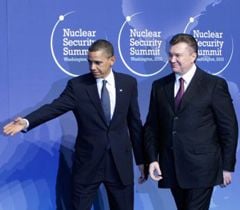
This time, he unloads tons of retrograde bullshitium.
Yanukovych: We have commenced systemic structural reforms that aim to create a powerful and modern technology economy...and secure high living standards for the population and protect its most underprivileged groups. Key in this regard is that by raising minimum welfare standards, we have managed to substantially reduce the portion of the population living below the poverty line.
What on earth is he talking about? The IMFirtash-sponsored 50%+50% utility hike? The tax hike for small businesses? The crackdown on secondhand clothing stores? The 25% increase in crime rates?
Who gives a shit anyway? Guys who write upbeat articles like this and this?
Wait, maybe this will shed some light.
Yanukovych: We...from the very start...Dmitry Anatolyevich and I...agreed that we wouldn’t talk about the bad stuff...we’d better do it. That is why we came to Hlukhiv...to show that we have very serious intentions that we will be carrying out in our domestic and foreign policy.
The bad stuff. Oh yeah! That’s exactly what you’ve been doing back at home, right?
Luckily for you, it’s soooo *West* to tip-toe around some bad guys — useful bad guys, that is.
You care about your country. You care about denuclearizing everyone but yourself and your allies. You made it happen in Ukraine.
When my country gave up its nukes — the world’s third-largest arsenal — it didn’t happen in a referendum. It didn’t happen in a classroom. It happened in Kuchma’s bedroom.
You treasured my country’s ability to trade its national interests for nothing but IMF loans and some aid.
As you know, the loans did us no good and the aid fell short of delivering the results it did in Eastern Europe. After all, from your Moscowcentric point of view, Ukraine’s “fledgling democracy” didn’t belong in Europe. The State Department pigeonholed us into “Eurasia” (Non-West/Little Russia), a class from which we never really graduated.
Bottom line, you took advantage of Ukraine at a tender age.
In an ideal world, you should have kept your IMF loans/aid, and we should have kept some of our nukes. We should have developed in a different way politically, economically and militarily.
Hindsight is always 20/20. Now what about foresight?
By continuing to take advantage of Ukraine whenever you can, you’re turning friends of America into a scarce commodity here.
The more Ukraine gets raped at home and abroad, the more we Ukrainians will remember it. The more you support our corrupt leaders, the more we’ll resist it. And once the pendulum swings in our favor — in the Ukraine-first favor — we’ll try to do it right. We’ll try not to repeat the mistakes of the Orange era.
Ukraine (the world’s #1 pisseful nation) made headlines at the Nuclear Servility Summit.
After nuking Ukraine’s Constitution, President Yanukovych swapped a few bombs’ worth of enriched uranium for a sniff of support from Washington, plus change.
Who says free trade doesn’t work?
Some Ukrainian Americans (who obviously identify with Ukrainian culture but American interests) gave Yanukovych a warm welcome.
I don't blame you for praising the man's “чудові ідеї” (great ideas). After all, it’s a zero-sum game: You keep your nukes, we give up ours. You support our government, we suffer from it. You win, we lose.
That's what Transatlantic Trends says, a project of the German Marshall Fund of the United States (www.gmfus.org) and the Compagnia di San Paolo (www.compagnia.torino.it) with additional support from Fundação Luso-Americana (www.flad.pt), Fundación BBVA (www.fbbva.es), and the Tipping Point Foundation.
In 2009, seven-in-ten Europeans (70%) favor the European Union providing security assistance for emerging democracies such as Ukraine and Georgia. And a majority of Americans (68%) back Washington taking similar action. Strong majorities of NATO members (62%) and Americans (66%) favor NATO providing such assistance.
As a Ukrainian, I'm flattered but not at all placated.
Whatever the accuracy of the poll data, I consider such assistance unrealistic and unreliable. I take my cues from Moscow-first policies pursued in Washington and Berlin.
In the real world, Ukraine has only itself to rely on. And there's only one way Ukraine can deter aggression: renuclearize.
Faced with superior conventional forces on its northeastern border, Ukraine should build survivable nuclear forces capable of inflicting unacceptable damage in retaliation. If Pakistan can do it, so can Ukraine.
This would cost a lot of money but would save a lot of lives, on both sides.
Eland states my country’s name as “the Ukraine.” Most English-speaking Ukrainians consider such usage insulting or ignorant. To us, “the Ukraine” means a territory, not a country, and underscores centuries of Russian domination. Since independence, Ukraine has persuaded the U.N. and the U.S. to drop the article and switch from Kiev (the Russian name)to Kyiv (the Ukrainian name).
So either Mr. Eland knows little about Ukraine, or “the Ukraine” carries a coded message from the Independent Institute. By the way, Obama said “the Ukraine” during the presidential debates. To me, this came as a shock. How could the chairman of the Senate Subcommittee on European Relations say that? Hadn't he mentioned his visit to Ukraine in The Audacity of Hope?
Indeed, U.S. foreign policy toward Ukraine, in practical terms, is all about chicken Kiev change.
It can be summarized by the following quote from Don’t Admit the Ukraine into NATO:
In any honest assessment of U.S. security goals, the faraway Ukraine is not strategic to the United States. To Russia, given its history of being invaded by foreign powers, the Ukraine, a large neighboring country, is much more strategic than even its small Baltic neighbors.
So “the faraway Ukraine” is no longer as “strategic” as it was in 1993-1995, when Washington was twisting our strategic arms? And Ukraine has never been invaded? Not even by Russia?
In other words, “disarm and disown.” That’s the policy. Wait, how about this one: Wasn’t Czechoslovakia more “strategic” to Germany than it was to France and Britain when they signed the Munich Agreement?
A fool and his nukes are easily parted. When Ukraine — lulled by the “end of history” — gave up its nuclear deterrent, it did one hell of a foolish thing. It gave up power and got poverty in return. The IMF loans we received in exchange for our 5,000 warheads did not help us to the “sweet harvest” that U.S. President Bill Clinton promised us. Instead, they helped our President Kuchma convert his sweet reform rhetoric into an overnight billion dollar fortune for his family.
Contrary to Western clichés, Ukraine did not just “inherit” its nuclear arsenal from the USSR. Ukraine invented and ingested a huge part of that arsenal. Ukraine produced some of the deadliest ICBMs in the Soviet nuclear forces and, on orders from Moscow, deployed them on its territory. Ukraine paid the price of collectivization, industrialization, Chernobyl and grabitization.
Now, what benefits did Ukraine get from its denuclearization? Or, in a narrow sense, what did “friends of America” in Ukraine get from “friends of Ukraine” in America? Prosperity? No. A ticket to Western Civilization? No. Constant threats from Moscow? Yes. A bunch of appeasement artists from Washington? Yes!
So what should Ukraine’s story tell Iran and North Korea?
A. Hey, why don’t you drop your weapons like Ukraine did? B. Hey, why don’t you follow Ukraine into the NPT and the MTCR? C. Wanna be bossed around? D. Wanna get your chicken change?
Finally, what effects would Russia's appeasement-induced adventurism have on U.S. security goals?
That’s the foreign policy prescribed by a “high-level bipartisan commission” in Washington. Below are excerpts from the IHT article Panel flags state of U.S.-Russia relations:
The panel was headed by Gary Hart, a former Democratic senator from Colorado, and Chuck Hagel, a former Republican senator from Nebraska. Its members include two former national security advisers, Brent Scowcroft and Robert C. McFarlane; Sam Nunn, a former Georgia senator experienced in Russia issues; and Lee H. Hamilton, a former chairman of the House Foreign Affairs Committee.
The commission report said that the new administration should "accept that neither Ukraine nor Georgia is ready for NATO membership" but that it should also work with NATO allies to find other ways “to demonstrate a commitment to their sovereignty.” The United States, it said, does not now have “a compelling security interest” in NATO membership for either country.
“A special relationship with NATO short of membership could serve the same function as membership, and would be a useful way to ensure that those Ukrainians and Georgians seeking to join NATO do not become discouraged,” it said.
Russia needs to understand our unflagging commitment to the independence and security of countries like a Poland or a Czech Republic. On the other hand, we have areas of common concern.
Call me a nitpicker, but I had never heard the indefinite article applied to Poland or the Czech Republic in a context like this. Never had I imagined it being applied by a U.S. president, much less by a former chairman of the Senate Subcommittee on European Affairs.
Now, I’m not a native speaker of English and I'm not a stranger to different schools of thought. But I just wonder how countries “like a Canada or an Israel” would feel?
Vladimir Zhirinovsky, Vice Speaker of the Russian State Duma: Your country and economy will collapse. And what will NATO do? Georgia: Immediately there will be war with Abkhazia and Southern Ossetia. That's why NATO will never accept you, Ukraine and Georgia. And then there's a more important scenario. Suppose everything is fine in Ukraine and Georgia. But we here think that it doesn't benefit us. And never will NATO trade Russia for one hundred Ukraines and two hundred Georgias.
In 1998, Ukraine could have supplied the turbines for the Iranian power plant in Bushehr, but dropped out of the deal after Washington's sticks-and-carrots diplomacy.
But there’s still a lot of stuff in Ukraine that Iran might be interested in. All it takes to push the reset button is a little war in "Little Russia."
Will Washington take its chances and trade friends for favors?
When I said Obama should avoid the trap of a Moscowcentric “Chicken Kiev” foreign policy, I meant this (3:46):
Rep. Jerrold Nadler (D-NY): Now, we have not been willing, we have not been willing to put our priorities properly. We have not been willing to say to the Russians or the Europeans: "Hey Russia, we won't expand NATO into...into Ukraine and...uh-uh-uh...Georgia, right next to your borders, if you cooperate with us on Iran." We said the opposite. We said, in effect, that expanding NATO into Ukraine and Russia is more important to us than getting Russia’s cooperation on Iran. I think it’s the opposite way around. I think Iran and Israel are a hell of a lot more important than expanding NATO to Russia's borders. Why should we? What do we need it for? We've not been willing to say that.
Female voice: Because they invade Georgia. Nadler: So let them invade Georgia! It’s right next to them. Would we tolerate a foreign…a uh-uh-uh…a Russian army in Mexico? Which is more important to us: Georgia or Israel, frankly?
Male voice: What is more important to us: Czechoslovakia or Austria? Nadler: That’s a completely separate iss…completely different kind of question…
Male voice: Sorry about that. Nadler: …completely separate kind of question. You have to try to engage and you have to try to avoid war.
So what's the priority: appeasement or engagement?
The next time Rep. Nadler revels in illusions of zero-casualty appeasement and compares Mexico to South Ossetia, there’s something he should know.
Unlike Georgia, Ukraine possesses long-range missile technology that may fall into terrorists’ hands in case Russia invades Ukraine.
After relinquishing the world’s third-largest nuclear arsenal in exchange for non-aggression commitments from the U.S. and Russia, Ukraine joined the Missile Technology Control Regime in 1998.
Now, will Ukraine be able to control its missile technology in a state of war with Russia?
Still, there seem to be certain differences in how the two view Ukraine, as far as the debate can tell.
While Obama did not shortchange Ukraine on NATO membership prospects, he referred to us as “the Ukraine” and went on to discuss cooperation with Russia. (Obama mentions Ukraine 4:42 into the video.)
By contrast, McCain demonstrated a deeper grasp of our current affairs, emphasized the threat from Russia, and exhibited a warmer attitude toward Ukraine’s NATO track. (McCain mentions Ukraine 7:07 into the video.)
It’s up to the American people to decide who will be the next president of their country.
Whoever that will be, it’s important for Ukraine that the next U.S. president builds bipartisan consensus and ensures foreign policy continuity with regard to Ukraine.
Leaving Ukraine at the mercy of the Kremlin would encourage bully behavior and would effectively penalize Ukraine for relinquishing its nuclear arsenal, the world’s third-largest. For the West, the outcome would be a flood of refugees, a natural gas shock, and a spike in defense spending.
Make no mistake: The costs of coping with the Kremlin’s adventure far outweigh the costs of preventing it.